
Key ideas and motivation
Our aim is to make advanced cryogenic Penning-trap devices smaller, simpler and deployable. Portable cryogenic platforms will allow Penning-trap technology to move beyond a small number of specialised laboratories into real-world settings. The range of potential applications is vast, for instance in quantum technologies, such as microwave sensing and quantum radars, in high-precision mass spectrometry, and in many others.
Conventional Penning traps rely on superconducting solenoids, making them heavy, lab-based and extremely difficult to move. Our planar superconducting magnetic field sources are being developed using high-temperature superconductors with critical temperatures of around 92 K. This removes the need for 4 K cooling and drastically simplifies the required cryostat. This is the key factor which to make the geonium chip a deployable technology.
The challenge: make a "benchtop-size" cryostat for the geonium chip
We have developed a compact, benchtop-size cryostat that houses the geonium chip and its HTS magnetic field source, together with all the wiring needed for DC voltages/currents and RF/MW signals. The system is cooled by a commercial Stirling cryocooler with active vibration cancellation. It reaches a base temperature of around 45 K under full load, sufficient to operate the geonium chip. Further improvements to the radiation shielding will enable even lower operating temperatures, with a theoretical limit of 30 K.
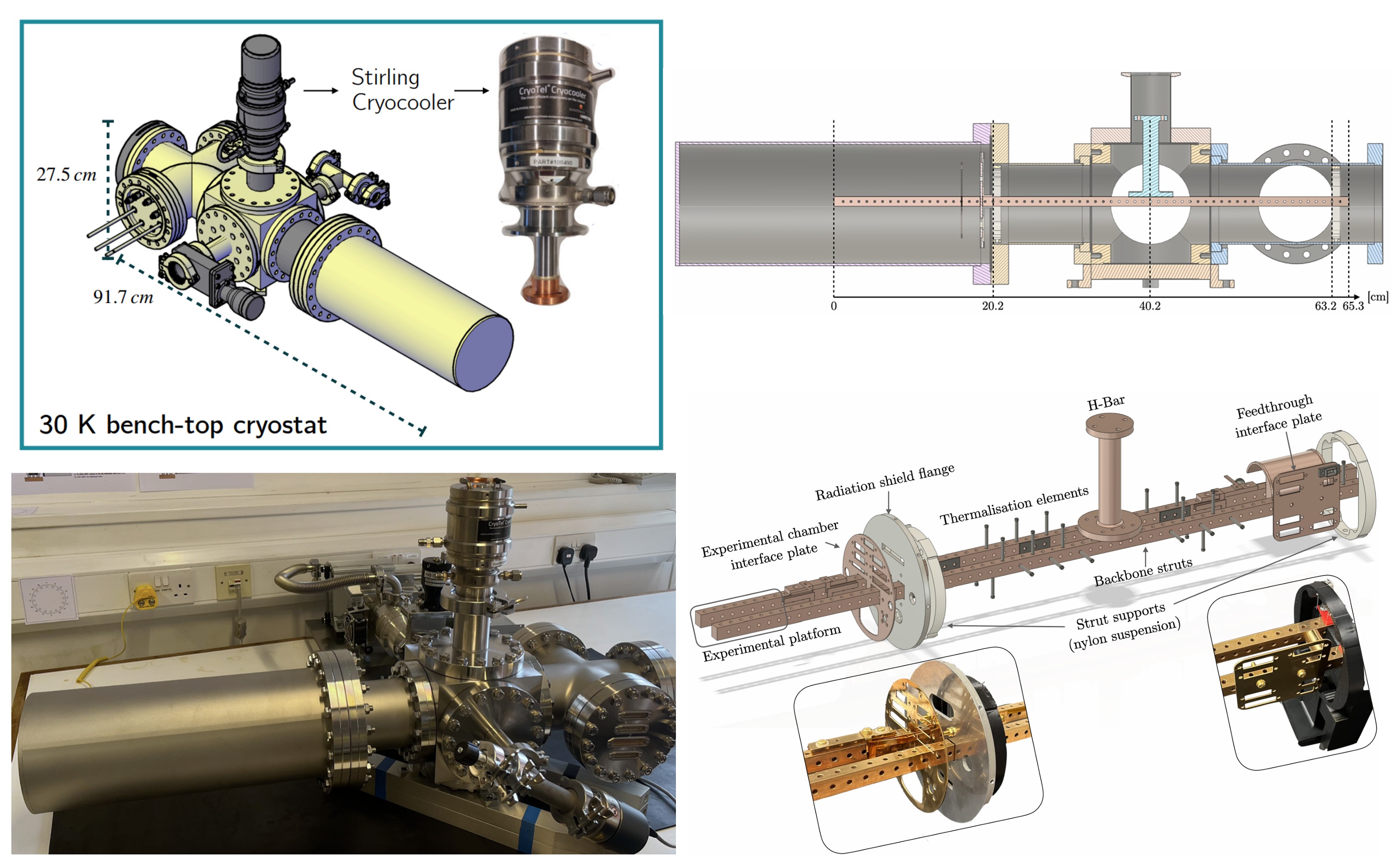
The design, implementation and performance details of the benchtop cryostat are discussed in detail in the PhD thesis of our group.
Operational benefits of our HTS magnet: cryogen-free operation
Our HTS planar magnetic field source will eliminate entirely the need for liquid helium cryostats. Compact cryocoolers, such as the Stirling cryocooler we use are closed-cycle systems, which make operation simpler, cheaper, and radically more accessible.
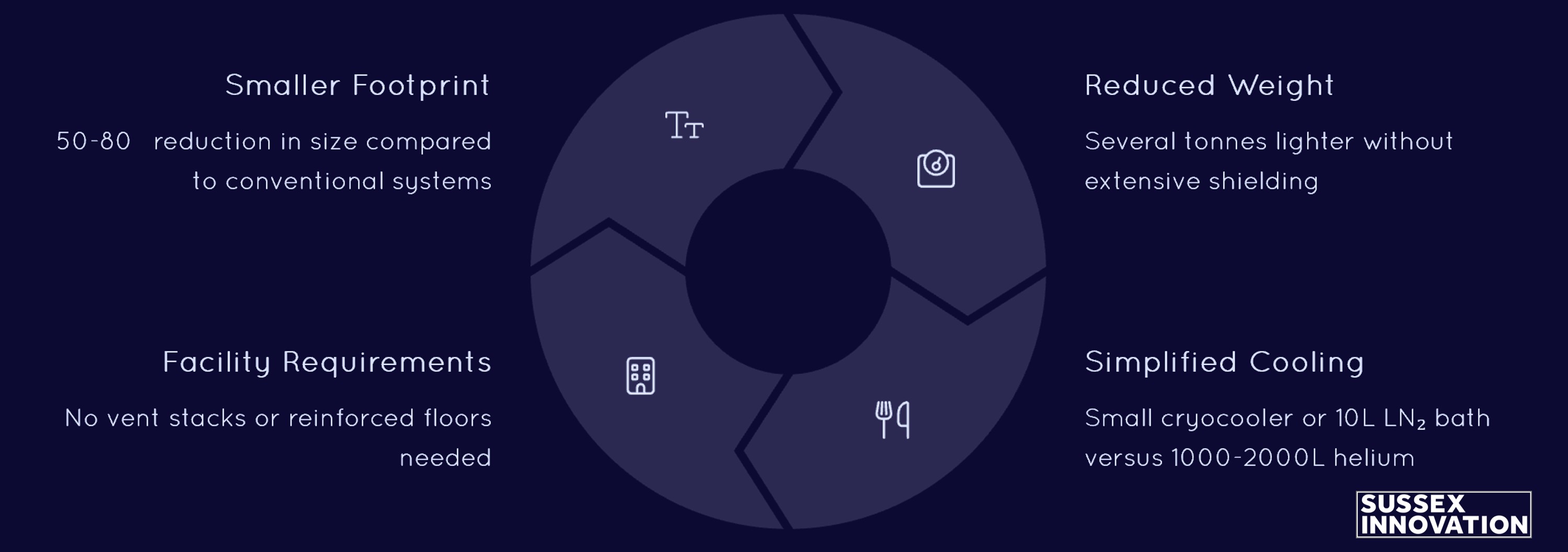
Helium is expensive, supply can be uncertain (30% of global supply goes through the strait of Hormuz), and its use adds heavy capital and operating costs, through cryogen handling and recovery infrastructure. Furthermore, often, the magnetic field is only needed in a very small working volume, yet the user still has to buy and operate a disproportionately large solenoid system. Our HTS magnetic field source and its portable cryogenic platform will solve many of these issues.