
Key ideas and motivation
Our group has been the first to propose the use of trapped electrons as quantum microwave sensors. The seminal article discussing the basic principles is Single microwave photon detection with a trapped electron.
A trapped electron is an exceptionally sensitive detector of microwaves, able to detect fields down to the single-photon limit. Its rotation around the magnetic field is characterised by the cyclotron frequency \(\omega_p\simeq\frac{q}{m}B\), where \(q\) and \(m\) are the particle’s charge and mass, and \(B\) is the magnetic field strength. For example, at \(B=1\) T, the cyclotron frequency is 28 GHz, placing it well within the microwave range. This makes the electron’s cyclotron motion a natural quantum receiver and emitter of microwave photons. The frequency can be easily tuned, simply by changing the magnetic field strength or the trapping voltages.
The electron’s cyclotron motion has the same quantum harmonic oscillator structure as the electromagnetic field. This makes it naturally well suited to detect or emit complex multi-photon quantum fields beyond single-photon signals. Moreover, a trapped electron can operate at moderate cryogenic temperatures, avoiding the need for the dilution refrigerators required by many other quantum microwave sensor technologies.
The electron enables the quantum non-demolition detection (QND) of microwave photons. This is made possible by its axial motion: an additional degree of freedom with a characteristic axial frequency, \( \omega_z\propto\sqrt{\frac{q}{m}} \), typically in the MHz range.
The trapped electron quantum microwave transducer (emitter and receiver) has a wide range of potential applications. One direction we are exploring is its use as a building block for quantum radar.
The challenge: detect minute microwave signals buried in noise
Microwave photons are difficult to detect individually because their energy is around six orders of magnitude smaller than that of visible photons. Furthermore, the environmental noise in the microwave range is much larger than at visible wavelentghs. For instance at 28 GHz and for a bandwidth of only 100 Hz, a room temperature antenna with its impedance matched to free space (376 \( \Omega \)) generates a thermal noise of \(\sim 10^5\) photon/s. The trapped electron can produce quantum microwave signals with several thousand photons, thus usually much smaller than the ubiquitous noise.
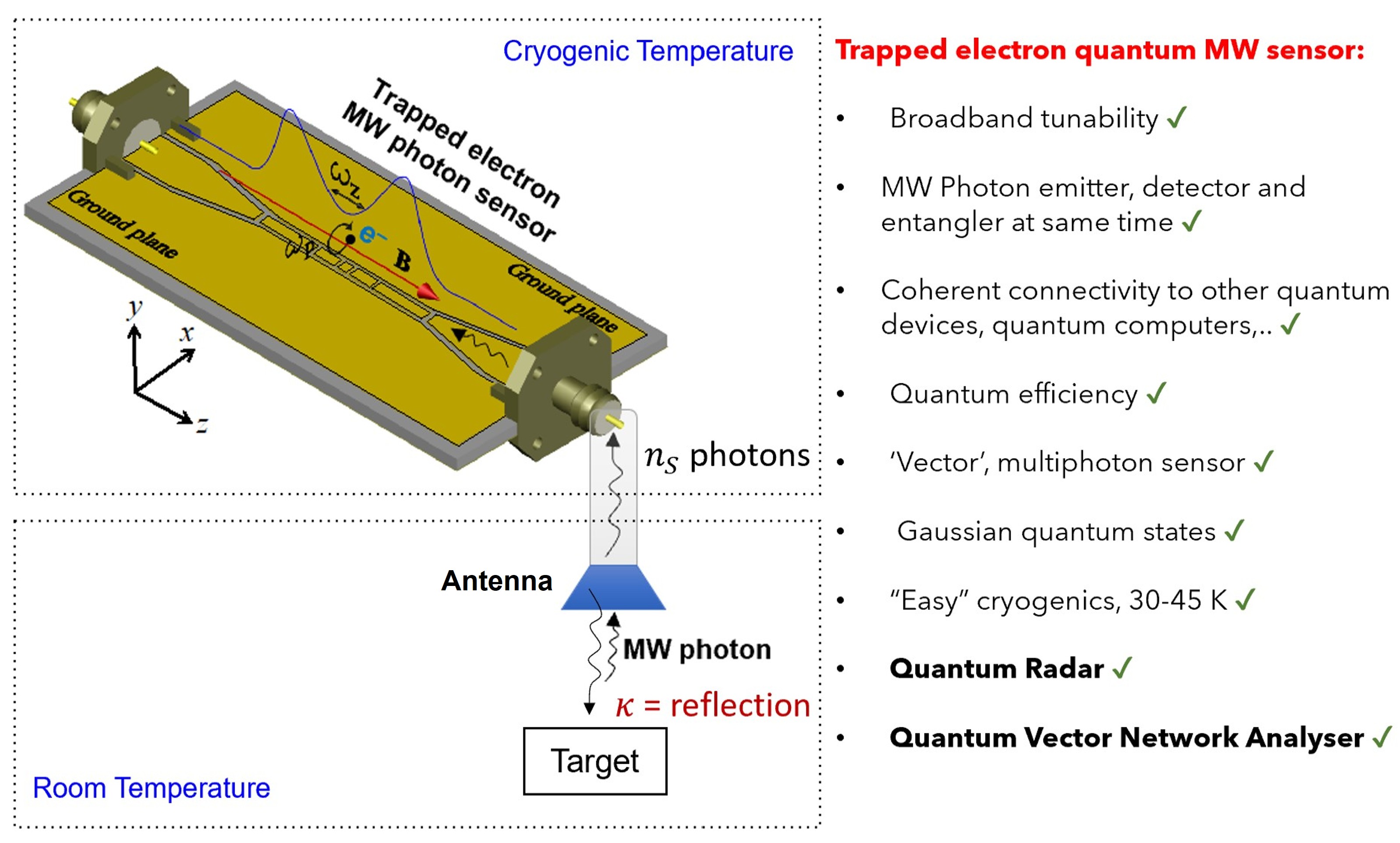
The figure above shows the basic microwave reflection measurement with an electron in a geonium chip. The electron produces \( n_s\) photons which travel to the target with a reflection coefficient \( \kappa\). A few signal photons bounce back and must be detected by the trapped electron. The reflected photons will always be in much smaller numbers than the noise. Thus, to distinguish the signal from the noise we need to apply advanced quantum metrology methods.
Quantum radar implementation with a trapped electron
The trapped electron is an ideal platform to implement the Gaussian quantum illumination protocol. This quantum metrology technique is described in Microwave Quantum Illumination. Quantum illumination relies on the creation of quantum correlated photon pairs: the "signal" and "idler" photons. The former travel to the target and bounce back. The received signal photons can be retrieved from the inevitable noise by measuring the surviving quantum correlations with the idler photons. These remain stored in the axial motion of the trapped electron.
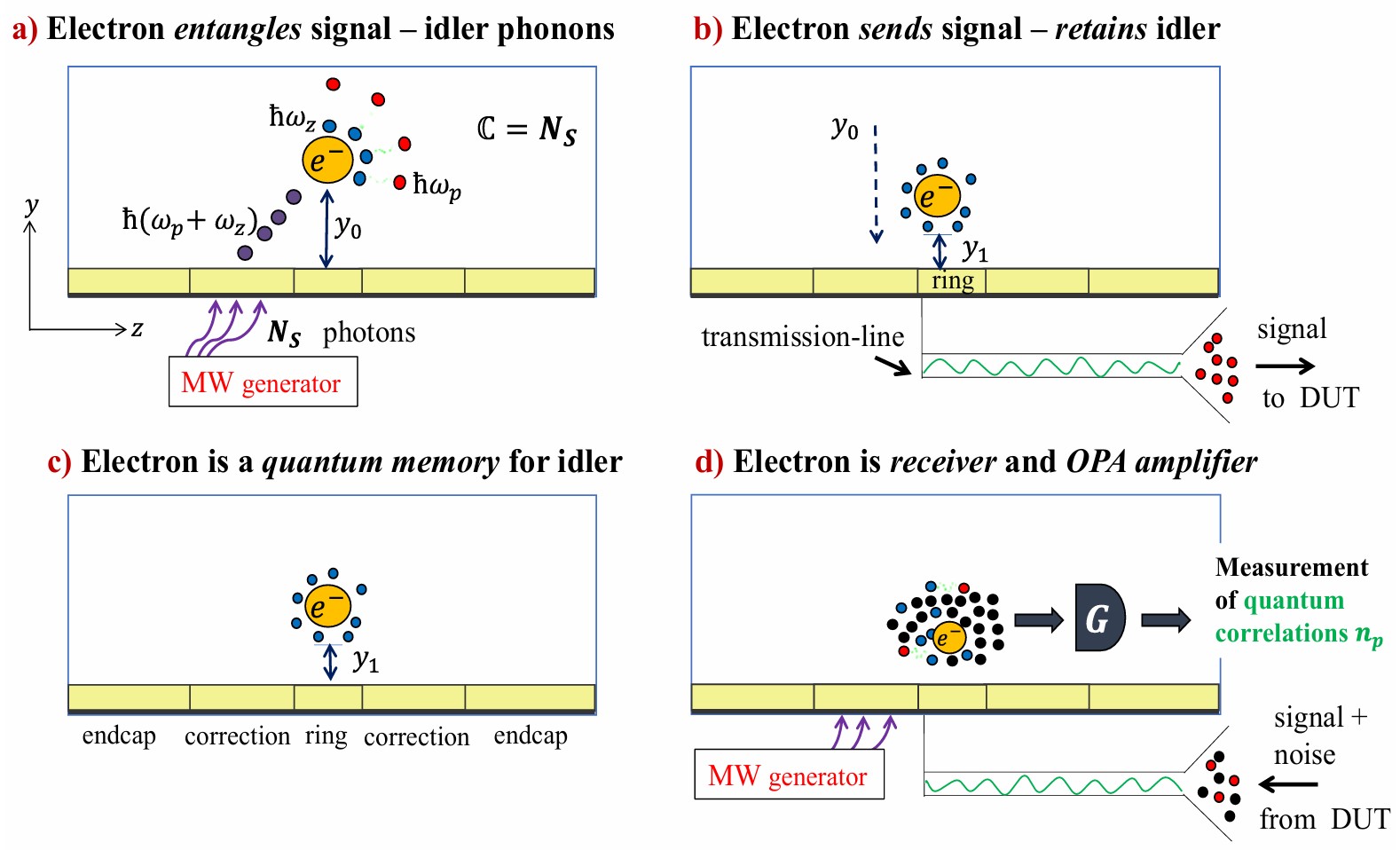
A quantum radar can be implemented using just one trapped electron as the entangler, storage, emitter, receiver and optical parametric amplifier of the quantum microwave radiation. These are all the sequential operations required for the quantum illumination protocol, as sketched in the figure above. A description of this method is decribed in our patent Quantum Illumination Using an Ion Trap. This work is funded by some of the most important stakeholders in the radar industry in the UK.
Quantum microwave sensing will provide new tools for detecting extremely weak electromagnetic signals. This will have applications in future quantum radars, in quantum communication, in fundamental physics experiments such as the neutrino-mass meassurement from tritium beta decay, and in many others.