
Key ideas and motivation
In a cryogenic trap, the motion of a trapped particle spans only a few hundred cubic microns. This means the magnetic field needs to be highly homogeneous only within a small region of a cubic mm or less, not across the much larger volume provided by a superconducting solenoid (cubic cm range).
This simple insight is central to the Geonium Chip.
Instead of relying on a large solenoid, we use a novel planar superconducting magnetic field source, combined with advanced shimming and flux-pumping techniques. This allows us to achieve magnetic field homogeneity and temporal stability comparable to traditional superconducting magnets, while greatly reducing the size, complexity and cost of the system.
Our superconducting planar magnet technology also allows for flexible, custom-shaped magnetic field distributions, with applications beyond the ion traps.
The challenge: create a homogeneous field with a planar magnet
A cylindrical coil naturally produces a nearly homogeneous magnetic field at its centre, thanks to its symmetry. Small remaining imperfections can be corrected with shimming coils. In a planar magnetic field source, this cylindrical symmetry is lost. However, by carefully tuning a set of shimming currents, we can create a highly homogeneous field in the region where the particles are trapped. This shimming is key to our planar magnet technology, and is illustrated in the figure.
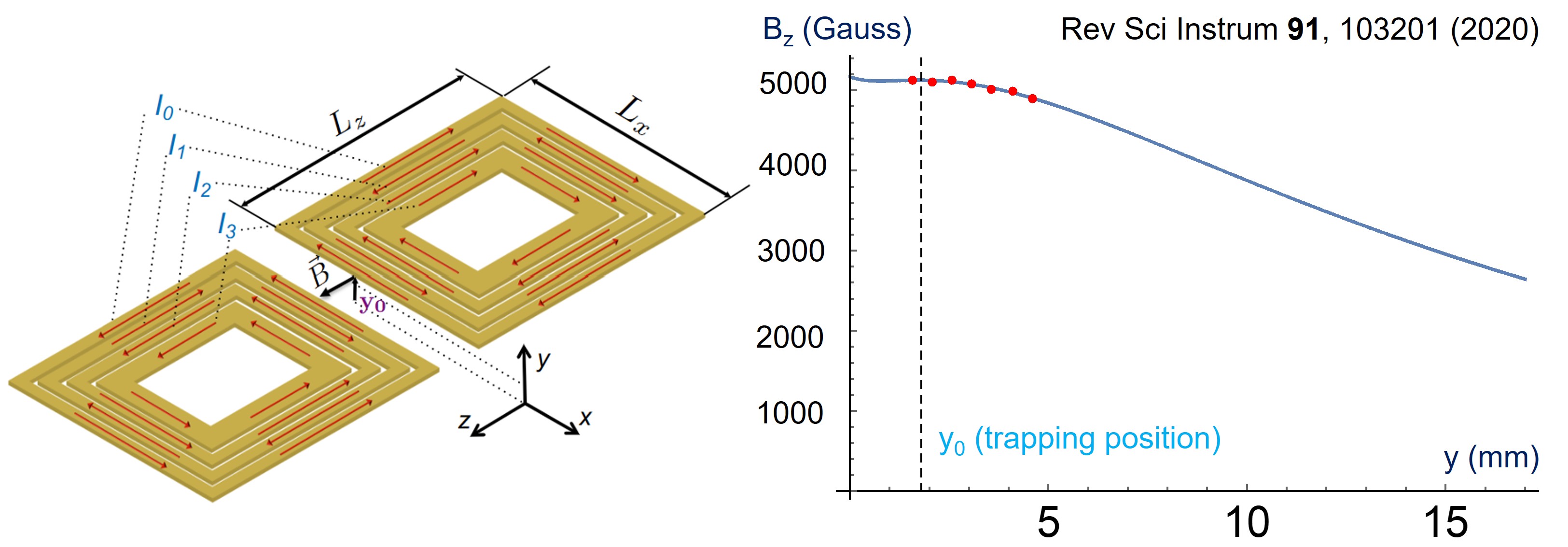
Planar superconducting structures can offer new degrees of freedom for field engineering, making it possible to generate magnetic-field profiles that are difficult or impossible to obtain with conventional solenoids. We have protected the IP of this planar magnetic shimming technology through several international Ion Trap Patents.
The first prototype: demonstration of the planar magnet technology
We have built the first prototype of our planar magnet technology: four concentric current loops made from NbTi superconducting wire, with a critical temperature of 9.2 K. The prototype demonstrates the potential of this approach, generating magnetic fields of around 0.5 T a few millimetres above the surface, with homogeneity comparable to superconducting solenoids.
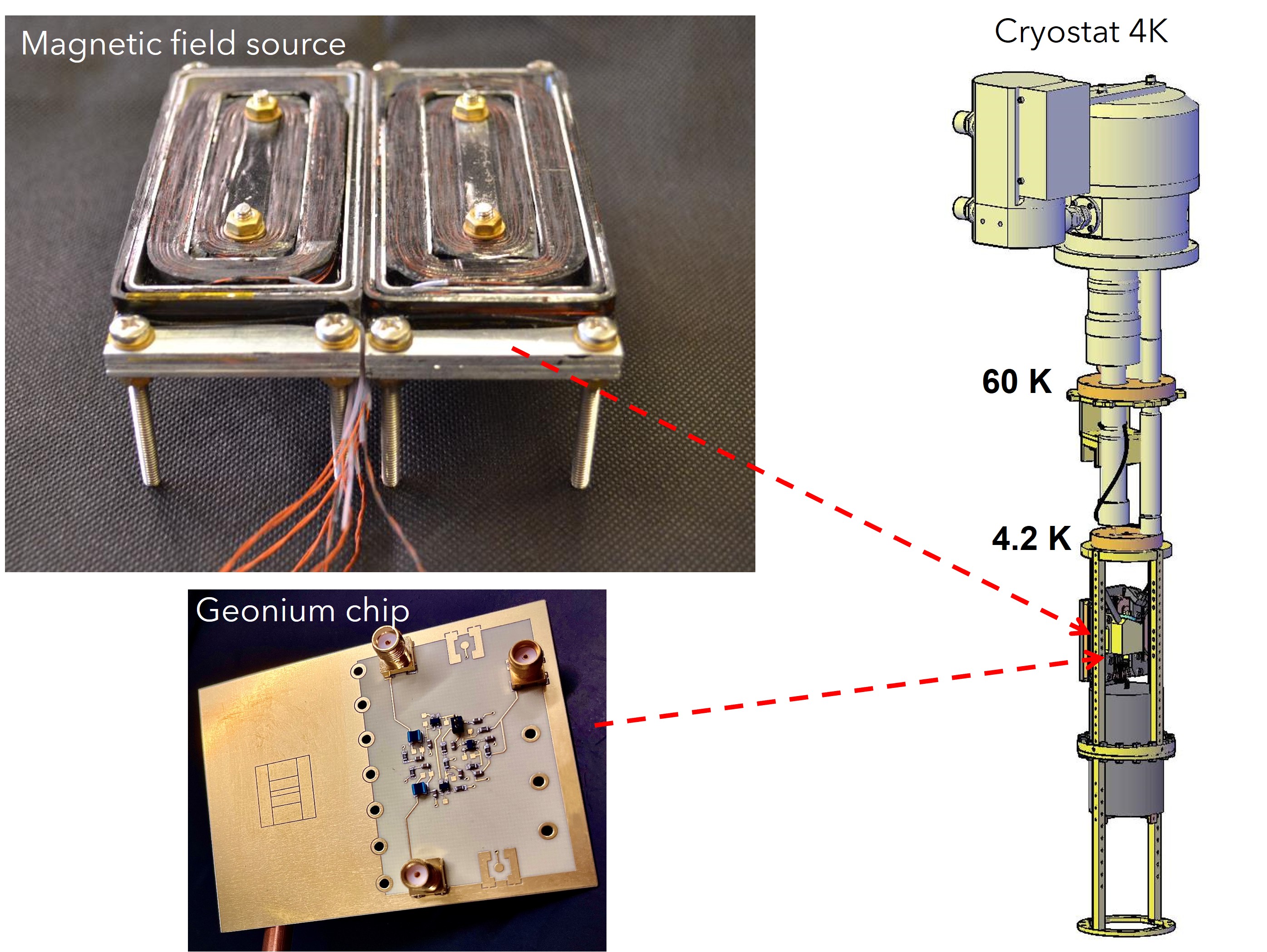
The design, fabrication, calibration and performance of our first planar magnet prototype are described in our publication, Planar, strong magnetic field source for a chip ion trap.
Flux pumping: eliminate bulky current leads and high current supplies
Creating Tesla-range magnetic fields normally requires very high currents, often tens or hundreds of amperes. Conventional superconducting magnets deliver these currents through very bulky current leads and high-current power supplies, which makes the cryostat larger and more complex.
To avoid this, we use a flux-pumping scheme. By building up magnetic flux step by step, our planar magnet can reach high fields using only small to moderate input currents.
The flux-pumping cycle we have developed is illustrated below, showing how magnetic fields can be built from low input currents.
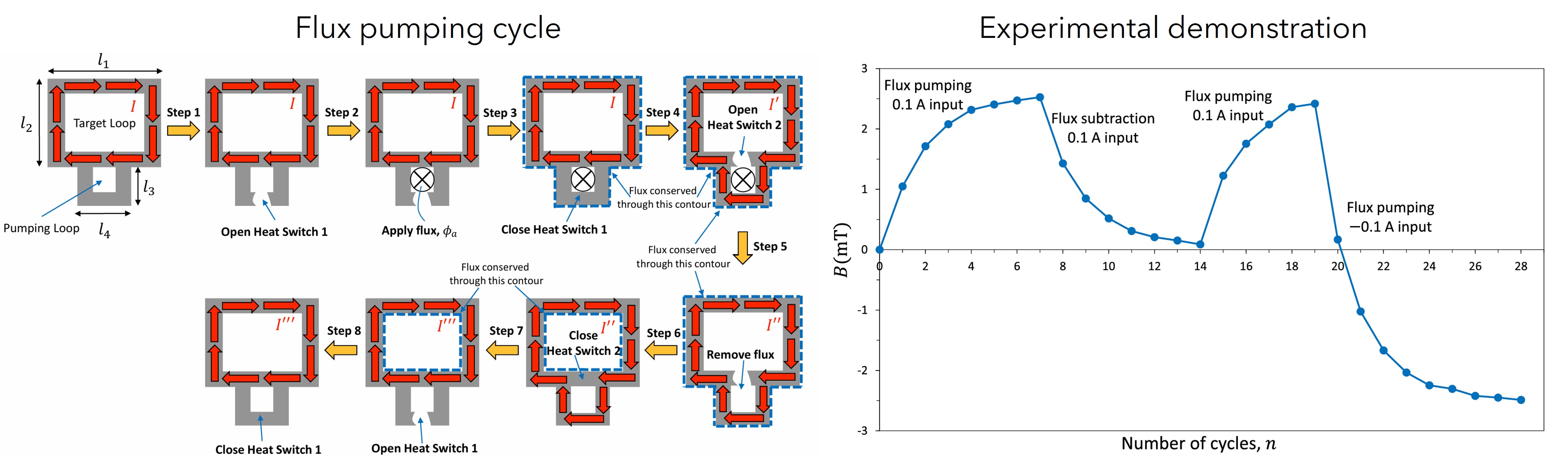
Our flux pumping technique has been developed and experimentally validated in a series of publications: Superconducting flux pump for a planar magnetic field source, and Flux pumping of multiple double-loop superconducting structures for a Planar magnetic field source. More details can be found in the published PhD thesis of our research group.
Persistent mode operation and High Temperature Superconductors
One key advantage of superconducting materials is that the magnet can operate in persistent mode. In this state, the currents built up through flux pumping continue to circulate without dissipation, providing a highly stable magnetic field without relying on current supplies.
We have now built a second-generation magnetic field source, machined from a single piece of NbTi with no current breaks or resistive soldered joints. This enables persistent-mode operation. The second-generation magnetic field source is shown in the figure below.
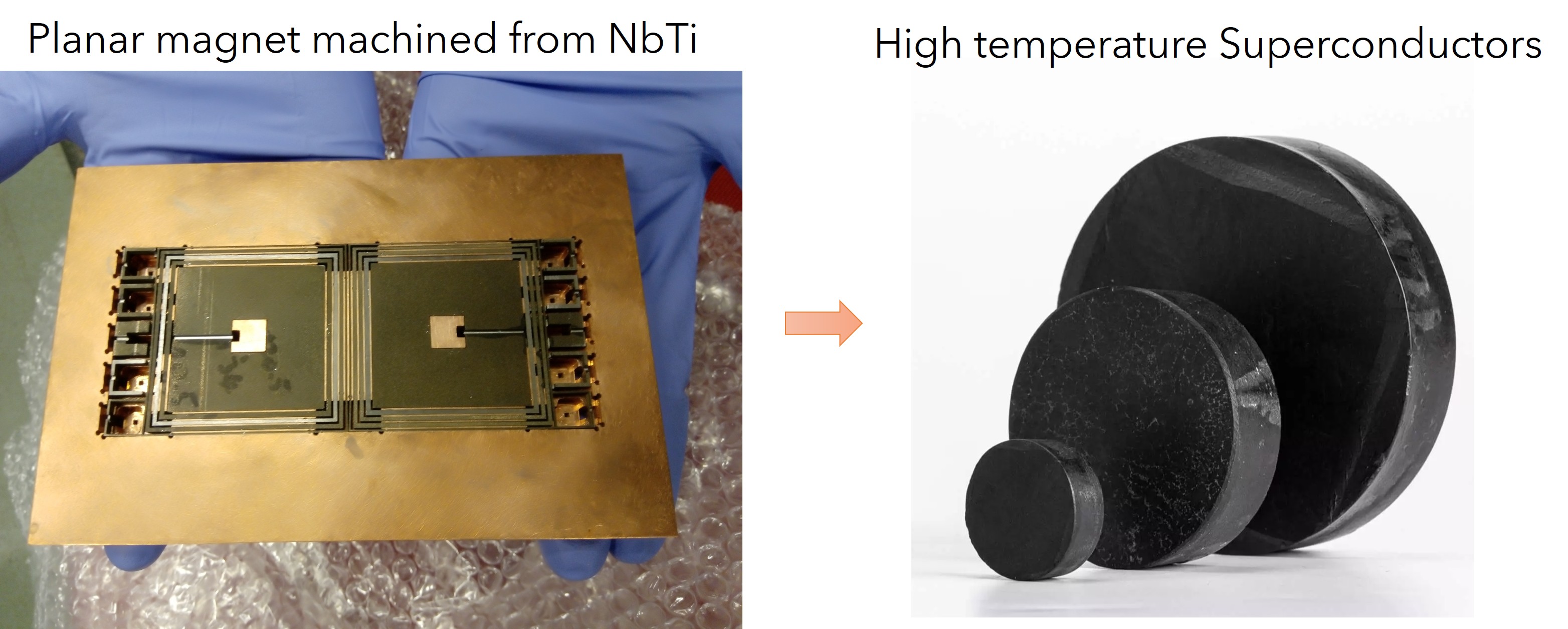
We are now developing our third-generation planar magnet, fabricated from high-temperature superconductors. This will remove the need for helium-based 4 K cryostats, making the magnet technology much simpler, more compact and more accessible to a wider range of users.